Fiber-Optic Internet: Benefits and Challenges of Deployment
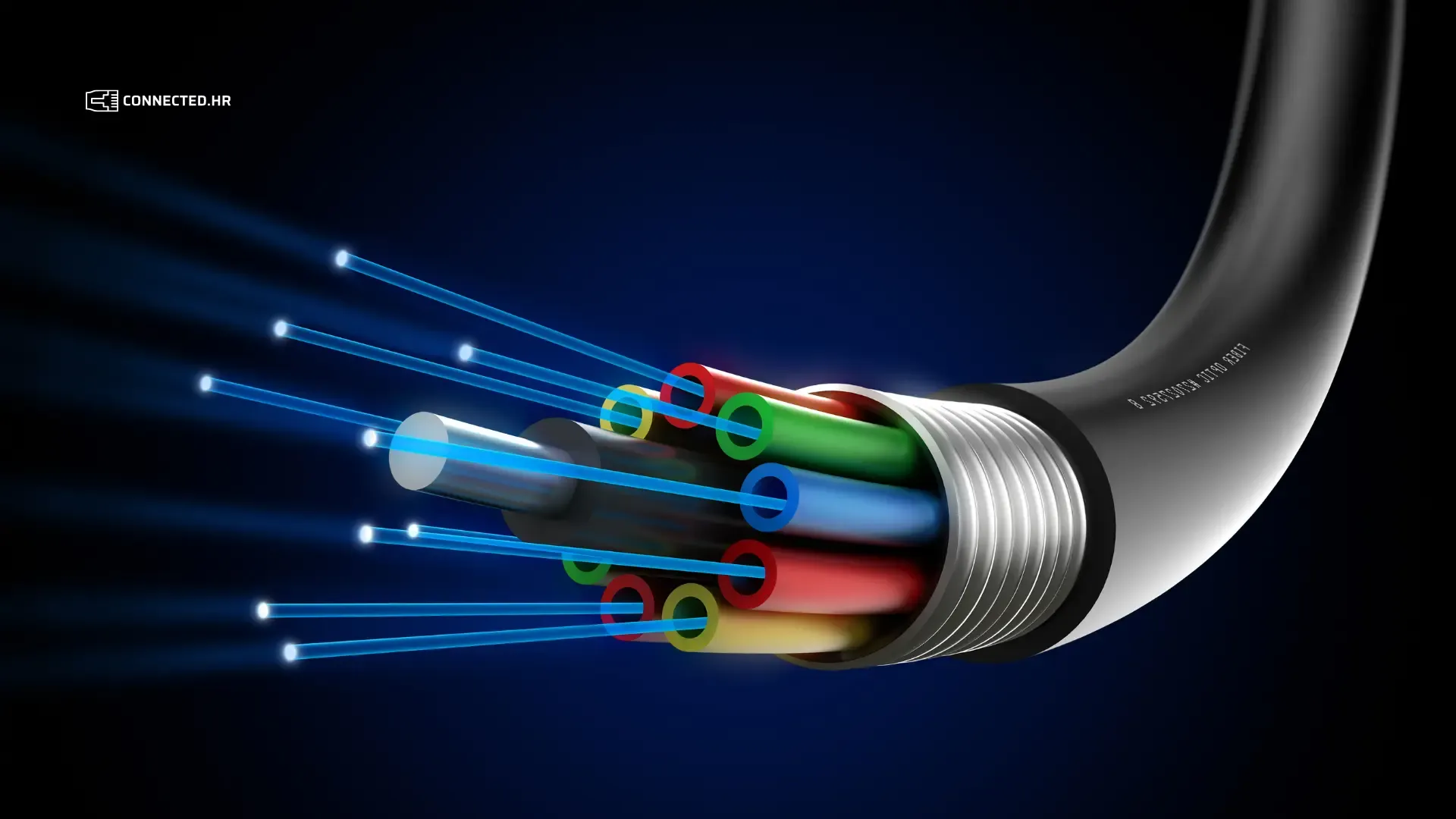
Fiber-optic internet is revolutionizing the speed and reliability of internet connections by using light signals to carry data through optical fibers.
The technology can transmit enormous amounts of data over long distances with minimal signal loss, which makes it the backbone of modern digital infrastructure.
In this article, we look at the history, technical aspects, benefits and deployment challenges of fiber-optic internet.
A brief history of fiber-optic internet
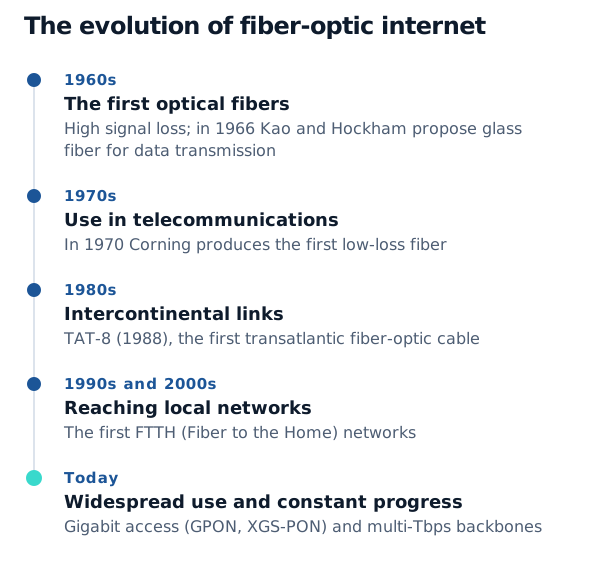
Fiber-optic internet has its roots in the invention of optical fibers in the 1960s. Scientists Charles Kao and George Hockham were the first to propose using glass fibers to transmit data, and in 2009 Charles Kao received the Nobel Prize in Physics for this work.
- 1960s: The first optical fibers are developed, still with high signal loss.
- 1970s: Corning Glass Works produces the first practical low-loss optical fibers, making them usable in telecommunications.
- 1980s: Fiber starts to be used for intercontinental links, with the first transatlantic fiber-optic cable, TAT-8, laid in 1988.
- 1990s and 2000s: Fiber spreads to local networks, and the first FTTH (Fiber to the Home) deployments appear.
Fiber deployment standards
The growth of fiber-optic internet went hand in hand with a range of standards that define how it is deployed:
FTTP (Fiber to the Premises)
This is an umbrella term for bringing optical fiber to commercial or residential premises. FTTP is a broad category that covers several specific deployment types. Its big advantage is that it delivers extremely fast connections to end users, whether they are individual households or large business complexes.
FTTH (Fiber to the Home)
This specific deployment brings optical fiber directly into individual homes. FTTH is the “purest” form of fiber-optic internet, with the fiber running all the way to the customer’s home.
It delivers the highest speeds and the lowest latency, because the signal travels over an optical medium the entire way. FTTH is ideal for densely populated areas where demand for fast internet is high.
However, deployment costs can be significant, especially in built-up areas.
FTTB (Fiber to the Building)
Here the optical fiber is brought to the building, and other technologies are used to distribute the signal inside it. FTTB is often the more cost-effective option for apartment buildings or business complexes.
Once the fiber reaches the building, the signal can be distributed over existing copper infrastructure (e.g. coaxial cables or Cat5/Cat6 Ethernet cables) or wirelessly.
This significantly improves connection speed and reliability compared with traditional copper connections, while keeping deployment costs lower than FTTH.
PON (Passive Optical Network)
This technology uses passive splitters to distribute the signal, reducing the need for active equipment and lowering deployment costs. In a PON architecture, a single optical fiber can serve multiple end users (typically 32 or 64) by means of optical splitters.
The splitters need no power supply, which cuts operating costs and simplifies maintenance. PON technologies include GPON (Gigabit PON), EPON (Ethernet PON) and newer variants such as XG-PON and NG-PON2, which offer even higher speeds. PON is particularly useful in densely populated areas, where deployment costs can be spread across a larger number of users.
Compared with copper networks
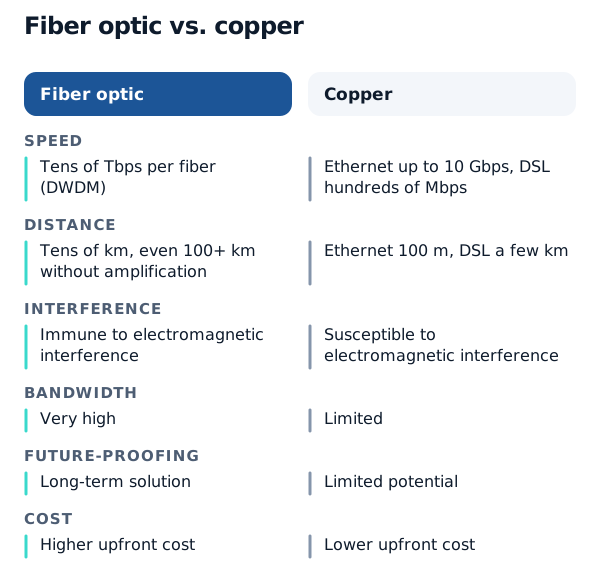
Fiber-optic internet offers significant advantages over traditional copper networks:
- Data transfer speed: Optical fibers can carry data at hundreds of gigabits per second, while copper networks reach up to 10 Gbps (Ethernet, over distances of up to 100 meters) and DSL connections hundreds of megabits per second over short copper loops.
- Transmission distance without loss of quality: Optical signals can travel tens of kilometers without amplification, whereas copper signals lose strength after a few hundred meters.
- Immunity to electromagnetic interference: Optical fibers are not affected by electromagnetic interference, which makes for a more stable connection.
- Infrastructure longevity: Optical fibers have a longer service life and are more resistant to physical damage than copper cables.
The future
The future of fiber-optic internet looks promising, shaped by several key trends:
- Higher transmission speeds: Research points to speeds of several petabits per second in the near future.
- Wider availability: Many countries are investing in national programs to expand fiber networks, particularly in rural areas.
- Integration with 5G networks: Fiber infrastructure will be essential to meet the growing demands of 5G networks.
- IoT and smart city applications: The higher bandwidth and lower latency of fiber networks will enable more advanced IoT applications and smart city services.
Common problems and solutions
Despite its many advantages, deploying fiber-optic internet comes with several key challenges:
- Cost: Significant upfront investment can be offset through public-private partnerships and strategic planning.
- Technical expertise: Ongoing training and specialization of technicians are essential for successful deployment and maintenance.
- Infrastructure constraints: Innovative techniques such as micro-trenching make installation possible even in demanding urban environments.
- Regulatory framework: Working with authorities to create a supportive environment speeds up fiber rollout.
Conclusion
Despite the challenges of deployment, fiber-optic internet is the future of fast and reliable connectivity.
Its ability to carry huge amounts of data over long distances with minimal delay is key to meeting society’s growing digital needs.
If you are having problems with your network, don’t hesitate to contact us.
We at Connected are here for you.
We are ready to solve all your networking challenges and keep you seamlessly connected.