Network Protocols: The Basics of TCP/IP and Other Key Protocols

Network protocols are sets of rules and standards that let different devices on a network communicate with each other.
Think of them as a universal language that allows your computers, smartphones and IoT devices to “talk” to each other and to the internet.
At the heart of this communication is the TCP/IP protocol suite, the foundation of modern internet infrastructure.
A brief history of network protocols
The development of network protocols began in the 1960s with ARPANET, the forerunner of today’s internet.
The pivotal moment came in 1973, when Vinton Cerf and Bob Kahn developed TCP (Transmission Control Protocol) and IP (Internet Protocol).
Known together as TCP/IP, these protocols became the basis of standardized network communication and were officially adopted in 1983 – marking the birth of the modern internet.
Standard network protocols
A number of standard network protocols form the backbone of internet communication.
They are widely accepted and implemented in most network devices and systems.
Here is an overview of the most important ones:
TCP/IP (Transmission Control Protocol/Internet Protocol)
- The foundation of internet communication
- TCP ensures reliable, ordered delivery of data
- IP takes care of routing data across the network
HTTP/HTTPS (Hypertext Transfer Protocol / Secure)
- Used to transfer web pages and other data on the web
- HTTPS adds encryption for secure communication
DNS (Domain Name System)
- Translates domain names (e.g. connected.hr) into IP addresses
- Essential for navigating the internet
DHCP (Dynamic Host Configuration Protocol)
- Automatically assigns IP addresses and network settings to devices on the network
- Simplifies network configuration
SMTP/POP3/IMAP (Simple Mail Transfer Protocol / Post Office Protocol / Internet Message Access Protocol)
- Protocols for sending and receiving email
- SMTP for sending, POP3 and IMAP for receiving
FTP (File Transfer Protocol)
- Used to transfer files between computers on a network
- For secure file transfer, SFTP (SSH File Transfer Protocol), which runs over SSH, and FTPS (FTP secured with TLS) are used
SSH (Secure Shell)
- Enables secure management of remote computers
- Commonly used for server administration
SSL/TLS (Secure Sockets Layer / Transport Layer Security)
- Protocols for secure communication over the internet
- Used to encrypt data in HTTPS
- SSL is deprecated and no longer considered secure, so TLS is used today (versions 1.2 and 1.3 are recommended)
SNMP (Simple Network Management Protocol)
- Used to monitor and manage network devices
- Important for maintaining large networks
ICMP (Internet Control Message Protocol)
- Used for network diagnostics and error reporting
- Ping, a popular tool for checking whether a host is reachable, uses ICMP
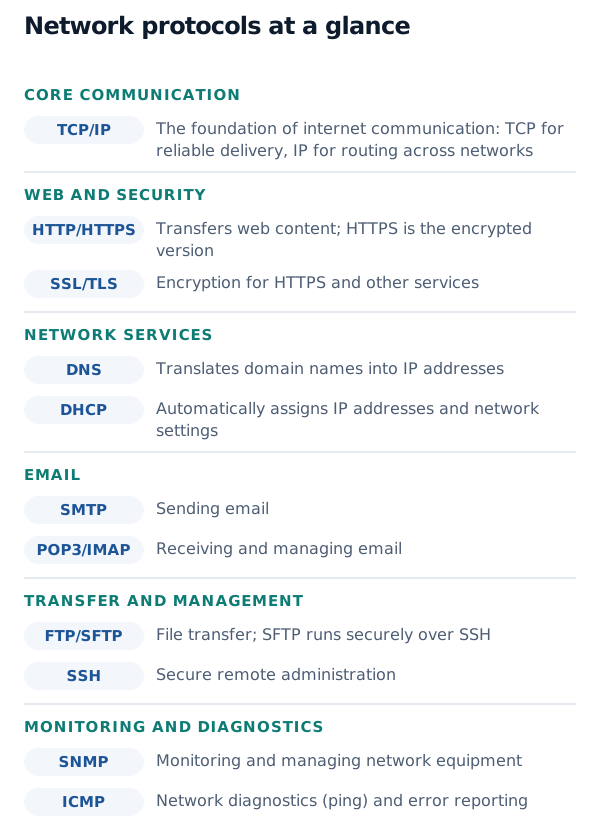
These protocols work together across the different layers of network communication, from the physical transmission of data up to application functions.
Understanding them is key to managing networks effectively and troubleshooting communication problems.
Comparisons
Each protocol has its strengths, depending on the use case:
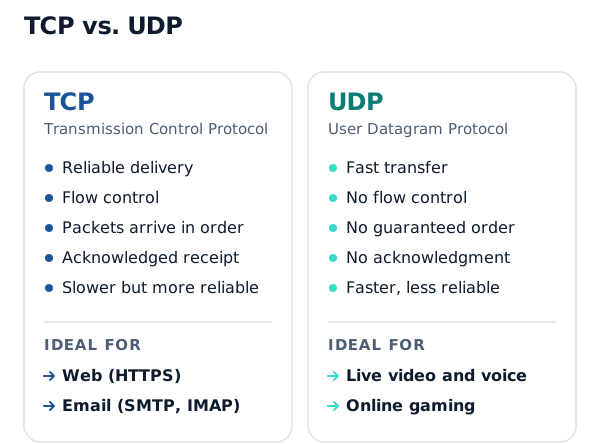
- TCP guarantees reliable delivery by checking and acknowledging receipt, which makes it ideal for applications that require accuracy, such as web browsers.
- UDP offers faster communication without delivery acknowledgments, which makes it well suited to streaming or online gaming, where speed matters more than the occasional lost packet.
- HTTPS adds a layer of encryption to standard HTTP, ensuring secure communication – especially important for online transactions.
The future
Future development of network protocols is focused on:
- Wider adoption of IPv6 to support the growing number of connected devices
- Protocols optimized for resource-constrained IoT (Internet of Things) devices
- Improved protocols for 5G and future generations of mobile networks
- Protocols designed for edge computing architectures
Common problems and solutions
Some of the most common issues with network protocols include:
- Network congestion: Advanced traffic management algorithms (QoS) and protocol optimization for more efficient use of bandwidth.
- Security vulnerabilities: Regular updates, more secure protocol versions (e.g. moving from HTTP to HTTPS) and end-to-end encryption.
- Compatibility between versions: Dual-stack systems that support several protocol versions at the same time (e.g. IPv4 and IPv6).
- Packet loss: Mechanisms for retransmitting lost packets and protocols that are more resilient to loss (e.g. TCP instead of UDP for critical data).
- Unauthorized access: Strong authentication mechanisms and encryption to protect against unauthorized access.
Conclusion
Network protocols are the backbone of modern digital communication. Understanding TCP/IP and other key protocols is not just a technical necessity – it is the key to understanding how our connected world works.
As technology advances, these protocols will keep evolving, adapting to the new challenges and opportunities of the digital age.
If you are having problems with your network, don’t hesitate to contact us.
We at Connected are here for you.
We are ready to solve all your networking challenges and keep you seamlessly connected.