Wired Networks: The Foundation of Modern Connectivity
In the digital age, wired networks still play a key role in how we connect every day.
While wireless technologies get more and more attention, wired networks remain the backbone of fast, reliable and secure communication.
In this article, we explore the world of wired networking: its history, standards, benefits and challenges.
A brief history of wired networks
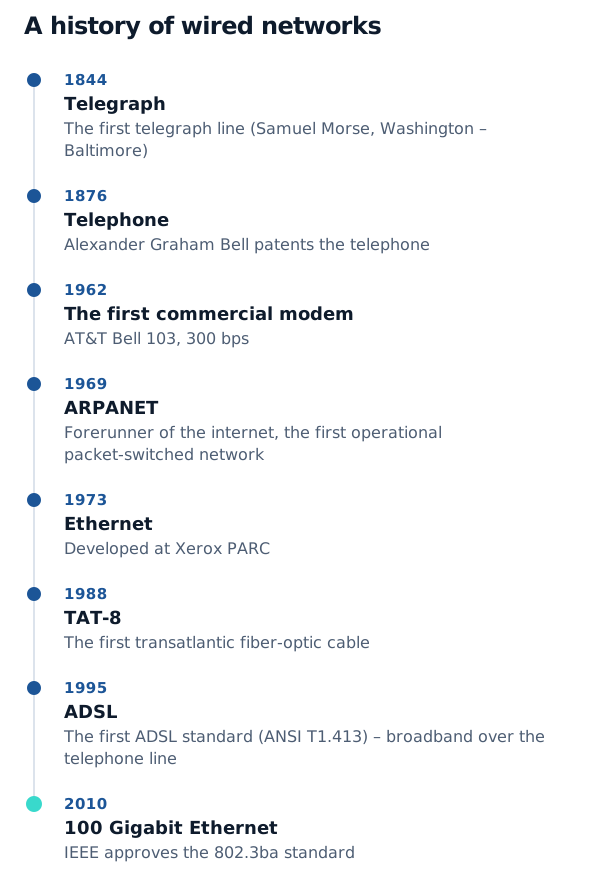
The history of wired networks goes back to the mid-19th century and the invention of the telegraph. Computer networks as we know them today, however, only began to take shape in the 1960s.
ARPANET, the forerunner of today’s internet, was launched in 1969 as the first operational packet-switched network. This pioneering system linked four universities in the US and demonstrated that resources could be shared over a computer network.
In the 1970s and 1980s, Ethernet and other LAN technologies made it possible to network computers efficiently within organizations.
The 1990s brought the explosion of the internet and broadband technologies, which greatly expanded the capabilities and reach of wired networks.
Wired network standards
Wired networks are built on a few key standards:
- Ethernet (IEEE 802.3): The most widespread standard for wired local area networks.
- Fiber optics (FTTx): For high-speed links over longer distances.
- DSL (Digital Subscriber Line): For broadband internet over telephone lines.
- Coaxial cable: Commonly used for cable TV and internet.
The evolution of Ethernet standards
Ethernet technology is constantly evolving. Here is an overview of the most important Ethernet standards:
10BASE-T (1990)
- The first widely adopted Ethernet standard
- Speeds of up to 10 Mbps
- Uses copper twisted pairs (UTP cable)
- Maximum segment length of 100 meters
100BASE-TX (1995)
- Known as Fast Ethernet
- Speeds of up to 100 Mbps
- Uses two pairs of a Cat5 UTP cable
- Kept the maximum segment length of 100 meters
1000BASE-T (1999)
- Known as Gigabit Ethernet
- Speeds of up to 1 Gbps
- Uses all four pairs of a Cat5e or Cat6 UTP cable
- Kept the maximum segment length of 100 meters
10GBASE-T (2006)
- The first standard for 10 Gigabit Ethernet over copper twisted pairs
- Speeds of up to 10 Gbps
- Requires Cat6a or Cat7 cable for the full 100-meter length
- Can run on Cat6 cable over shorter distances
40GBASE-T (2016)
- Part of the IEEE 802.3bq standard
- Speeds of up to 40 Gbps
- Requires Cat8 cable
- Maximum length limited to 30 meters
- The fastest Ethernet standard over copper twisted pair
100 Gigabit Ethernet (2010)
- Defined by the IEEE 802.3ba standard
- Speeds of up to 100 Gbps
- Runs over optical fiber or short twinax cables, not over copper twisted pair
- Used in data centers and network backbones
400 Gigabit Ethernet (2017)
- Defined by the IEEE 802.3bs standard
- Speeds of up to 400 Gbps
- Runs over optical fiber or short twinax cables
- Designed primarily for data centers and network backbones
- Uses multiple parallel lanes to reach such high speeds
- An even faster 800 Gigabit Ethernet (IEEE 802.3df, 2024) already exists
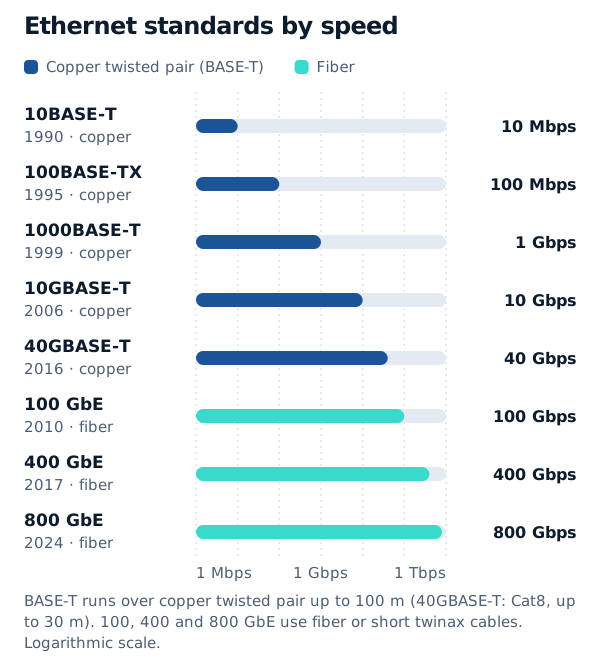
Each new generation of Ethernet brings significant gains in transmission speed, delivering the ever-higher throughput that modern applications and services demand.
Wired vs. wireless networks
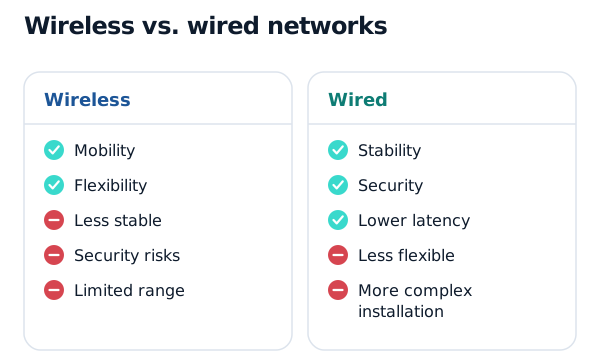
Wired networks offer a number of advantages over wireless networks:
- Higher speed and more stable connections
- Better security
- Lower latency
They do, however, come with some challenges:
- Less flexibility and mobility
- More complex installation
- Limited scalability
The future of wired networks
The future of wired networking looks promising, with technologies such as:
- Terabit Ethernet
- Advanced fiber-optic systems
- Power over Ethernet (PoE) improvements
These technologies promise even higher speeds, better energy efficiency and new applications.
Common problems and solutions
Some of the most common wired network issues include:
- Physical cable damage: Regular inspections and replacing damaged cables can prevent it.
- Distance limits: Use repeaters or fiber links to cover longer distances.
- Electromagnetic interference: Use shielded cables or fiber links in high-interference environments.
- Incompatible equipment: Make sure all network equipment supports the same standards and speeds.
- Network congestion: Implement Quality of Service (QoS) and network segmentation for better data flow.
- Security risks: Use firewalls and encryption, and keep network equipment up to date.
- Grounding issues: Properly ground all network equipment to prevent damage and interference.
- Poor cable terminations: Terminate connectors properly and use cable testers.
Conclusion
Wired networks remain the foundation of modern digital infrastructure, delivering the speed, reliability and security that critical applications require.
While wireless technologies get more and more attention, wired networks still play a key role in our connected world.
If you are having trouble with your wired network or need help setting one up, don’t hesitate to contact us.
We at Connected are here for you.
We are ready to tackle all your networking challenges and keep you seamlessly connected.