Wireless Networks: A Revolution in Connectivity
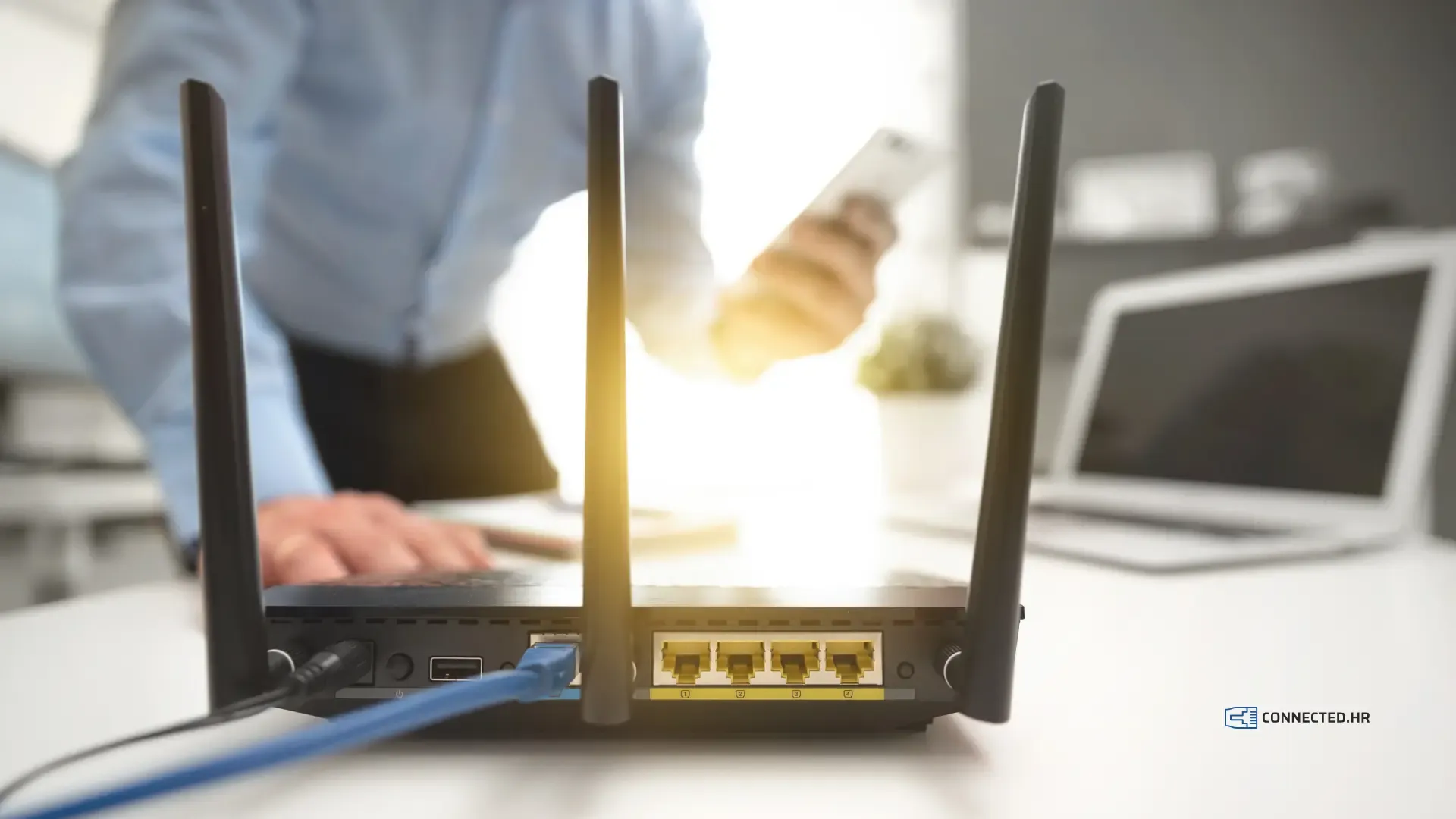
Wireless networks have become an essential part of everyday life.
From smartphones to IoT devices, they keep us connected without the limits of physical cables.
In this article, we explore the world of wireless networking: its history, standards, benefits and challenges.
A brief history of wireless networks
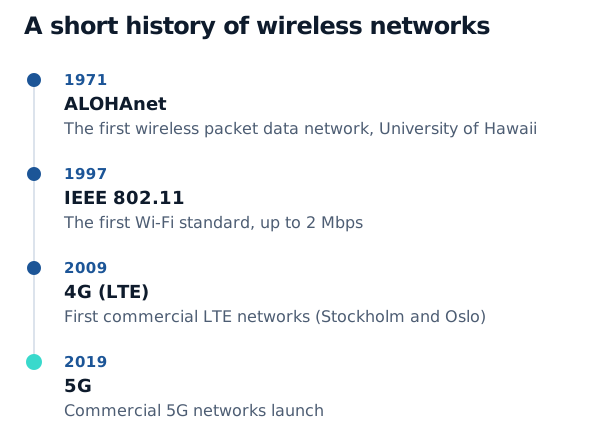
The idea of wireless communication dates back to the late 19th century, when Guglielmo Marconi demonstrated the first radio transmission. Wireless networks as we know them today, however, only began to take shape in the 1970s.
The first wireless packet data network, ALOHAnet, went live in 1971 as a research project at the University of Hawaii.
This pioneering system proved that computers could be linked without wires, laying the groundwork for the wireless technologies that followed.
In the 1980s, the first mobile phones brought wireless communication into everyday life.
The 1990s delivered a revolution in the form of digital mobile networks and the arrival of Wi-Fi, which greatly expanded the capabilities and reach of wireless communication.
Wireless network standards
Wireless networks are built on a few key standards:
- Wi-Fi (IEEE 802.11): The most widespread standard for wireless local area networks.
- Bluetooth: For connecting devices over short distances.
- Cellular (3G, 4G, 5G): For wide-area mobile networks.
- ZigBee: Commonly used in IoT applications.
The evolution of Wi-Fi standards (IEEE 802.11)
Wi-Fi technology is constantly evolving.
Here is an overview of the most important 802.11 standards:
802.11 (1997)
- The original standard
- Speeds of up to 2 Mbps
- Used FHSS (Frequency-Hopping Spread Spectrum) and DSSS (Direct-Sequence Spread Spectrum) techniques
802.11b (1999)
- Speeds of up to 11 Mbps
- Used the 2.4 GHz frequency band
- Made Wi-Fi popular for home use
802.11a (1999)
- Speeds of up to 54 Mbps
- Used the 5 GHz band
- Less interference, but shorter range than 802.11b
802.11g (2003)
- Speeds of up to 54 Mbps
- Used the 2.4 GHz band
- Backward compatible with 802.11b devices
802.11n (2009)
- Speeds of up to 600 Mbps
- Introduced MIMO (Multiple-Input Multiple-Output) technology
- Can use both the 2.4 GHz and 5 GHz bands
- Greater range thanks to beamforming
802.11ac (2013)
- Theoretical speeds of up to 6.9 Gbps
- Uses the 5 GHz band exclusively
- Introduced MU-MIMO (Multi-User MIMO) for simultaneous communication with multiple devices
- Wider channels (up to 160 MHz) for higher data rates
802.11ax (Wi-Fi 6, 2019)
- Speeds of up to 9.6 Gbps
- Better efficiency in crowded environments
- Introduced OFDMA (Orthogonal Frequency-Division Multiple Access) for better resource allocation
- Target Wake Time (TWT) to save energy on mobile devices
- Operates at 2.4 GHz and 5 GHz; the Wi-Fi 6E variant also uses the 6 GHz band
802.11be (Wi-Fi 7, 2024)
- Theoretical speeds of up to about 46 Gbps
- Operates in the 2.4 GHz, 5 GHz and 6 GHz frequency bands
- Multi-Link Operation (MLO) for using several frequency bands at once
- 320 MHz wide channels for even higher speeds
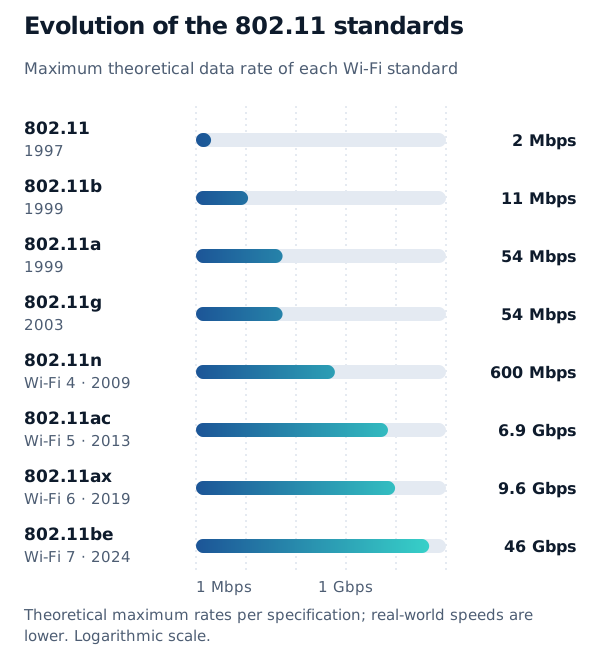
Each new generation of Wi-Fi brings significant improvements not only in speed but also in reliability, spectrum efficiency and support for more simultaneously connected devices.
This evolution is essential to keep up with the growing number of connected devices in our homes and offices, and with new applications such as virtual reality, 4K and 8K streaming and Internet of Things (IoT) devices.
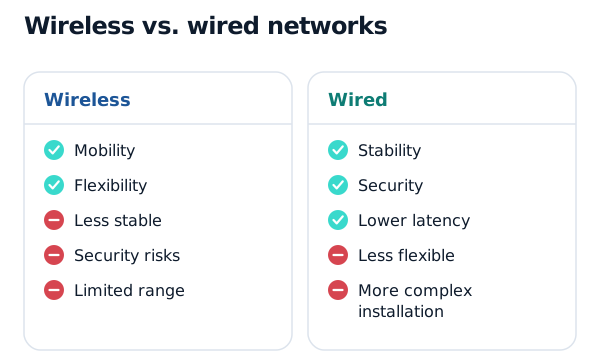
Wireless vs. wired networks
Wireless networks offer a number of advantages over traditional wired networks:
- Mobility and flexibility
- Easier installation
- Scalability
They do, however, come with some challenges:
- Potentially lower speed and less stable connections
- Security risks
- Limited range
The future of wireless networks
The future of wireless networking looks exciting, with technologies such as:
- Upcoming 6G networks
- Wi-Fi 7 (802.11be)
- Li-Fi (Light Fidelity)
These technologies promise even higher speeds, lower latency and improved reliability.
Common problems and solutions
Some of the most common wireless network issues include:
- Weak signal: Adding a repeater or a mesh system can solve it.
- Interference: Switching to a different channel or frequency band can help.
- Security risks: Use strong encryption and change passwords regularly.
Conclusion
Wireless networks have revolutionized the way we connect and communicate.
Despite their challenges, their future looks bright as technology keeps advancing.
If you are having trouble with your wireless network or need help setting one up, don’t hesitate to contact us.
We at Connected are here for you.
We are ready to tackle all your networking challenges and keep you seamlessly connected.